PULSE Long Service Leave Calculation
This document describes the calculation of Long Service Leave (LSL) in the Pulse Payroll System
All efforts have been made to ensure the accuracy of this document, and whilst due care is taken to ensure that the information contained in this document is correct at the time of printing; Jonas Leisure Australia does not assume responsibility for errors nor for any consequences arising from errors in this document.
Pulse reminds all clients that we are not expert in Industrial Law. If in doubt you should seek the appropriate expert opinion
Introduction
Unlike most other aspects of payroll administration, long service leave is controlled by state legislation. In NSW the Long Service Leave Act 1955 is an old piece of law and in some respects has not kept up to date with changing workplace conditions. In particular it provides little assistance in prescribing the calculation method for part-time and casual employees that work irregular hours from week to week.
After discussion with clients and the NSW Department of Industrial Relations it has been decided to implement the Queensland method of leave calculation within the system. The method uses the following formula to calculate LSL.
H = T/52 * A
Where:
H = the calculated number of leave hours to which the employee is entitled or has accrued.
T = the total ordinary hours worked in the period.
A = the annual entitlement in weeks.
For example, in a ten year period an employee has worked a total 12,251 hours. The entitlement to LSL on the tenth anniversary of employment will be…
H = 12,251 / 52 * 0.86667 or 204.18 hours.
This formula has the following advantages
1. It is computationally simple and easy to check.
2. It works over any time period and for any employment type (full time, part time or casual).
3. It is fair to employees who work many weeks in a period compared to those who only work a few.
4. The same algorithm can be used to calculate annual and personal leave entitlement where applicable. For example, substitute 0.86667 with 4 to calculate annual leave.
Entitlement versus Accrual
In addition, the PULSE payroll system enforces the strict interpretation of an entitlement and an accrual.
- An entitlement is the leave an employee is entitled to take. During the course of employment this is two months after ten years of service and one month for every five years thereafter (averaged for part-time and casual employees). The exception is on termination where an employee is normally entitled to the full accrual up to and including the termination date.
- An accrual is the hours accrued from the start of employment up to and including the date of calculation. Accruals are normally only used for calculating leave provisions in the balance sheet.
For example, a full time 38 hours/week employee has been employed for exactly 13 years. The employee’s entitlement to LSL is 80.6667 hours (two months leave). The accrual for that employee is 112.67 hours.
The implication of this is the Long Service Leave entitlement printed on employee payslips is their entitlement not their accrual.
Requirement to keep hours history
The formula used to calculate LSL requires ordinary hours history be maintained for a minimum of five years. In the Pulse Payroll system, Pay history is kept on record for a period of seven years after the employee has terminated.
However, clients that have converted to Pulse from another third party system will need to review their data and possibly take remedial action.
If you decide that remedial action is required, remember you need only be concerned with casual and part-time employees with five or more year’s continuous service.
Examine the pay history for a long term employee
In the Enquiry Application change the start date to at least five years past and click Apply.
Select the employee and click the Process button.
Check the first date listed in Pay History and make sure it is at least five years old
Maintains System Option Settings for Payslips
.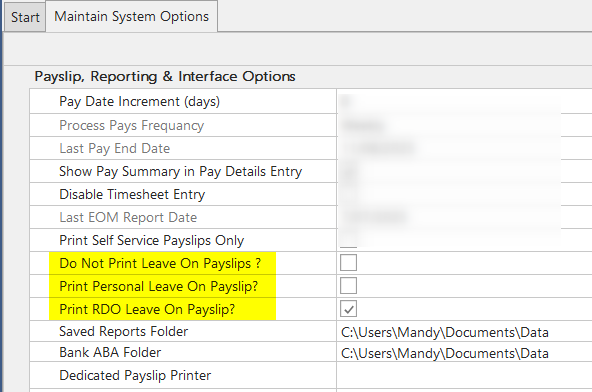
Do Not Print Leave on Payslips?
Check if you do not want leave entitlement details to be printed on payslips.
Print Personal Leave on Payslip?
Check if Personal leave is to be printed on payslips. For this option to have affect, Do Not Print Leave on Payslips? must be unchecked.
Print RDO Leave on Payslip?
Check if accumulated additional roster days off entitlement is to be printed on the payslip. For this option to have affect, Do Not Print Leave on Payslips? must be unchecked.
Related Articles
Pulse - STP reports
It is important that the employment history details on an employee’s record are correct to ensure the accurate submission of dates to the ATO. Importantly, never change the record type from Terminated to Commenced but, rather create a new ...Pulse - PAYROLL - How to enter a new pay rate
1. First step is calculating what the base rate will be. For example,…. If the salary is to be $50,000 per year. Then to calculate it is $50,000/52 (weeks per year) = $961.53 per week $961.53/38 (hours per week) = $25.3034 per hour 2. If you are ...Pulse: Pulse Protected Earnings (PEA)
Question How is the Protected Earnings Amount entered in the system Answer Search through Pulse's Inbuilt help on Protected Earnings or PEA The amount is hardcoded by the developer on the 1st Jan each year. This amount is updated automatically in the ...Pulse: Payroll EOY Guide 2026
Attached is the guide to process EOY in Pulse payroll. At this stage an Pulse Workspace update is not required. When the update is available all Pulse contacts will be advised.to download and start the configuration changes in Services Providers for ...Ozedi(Pulse) Quick Start Guide & other information for Payday Super
The attached guides assist Pulse Payroll sites to set up their clients in Ozedi to start using their Superannuation Service for PaydaySuper. Details as below: Ozedi Registration link: ...